



AI Data Centers Are Being Built Where Local Journalists Aren’t
Half of the projects are landing in communities with too few reporters to scrutinize their costs and benefits
As developers and investors pursue more AI data centers nationwide, we at Rebuild Local News wanted to know: What is the relationship between where data centers are being built and how much local reporting capacity exists to cover them?
The answer is striking. The AI boom is arriving fastest in some of the places least equipped to cover it.
To examine the relationship, we matched the FracTracker Alliance’s database of U.S. data centers against the Muck Rack and Rebuild Local News 2026 Local Journalist Index, which measures Local Journalist Equivalents (roughly equivalent to one full-time reporter). The average is 7.8 Local Journalist Equivalents per 100,000 in the country.
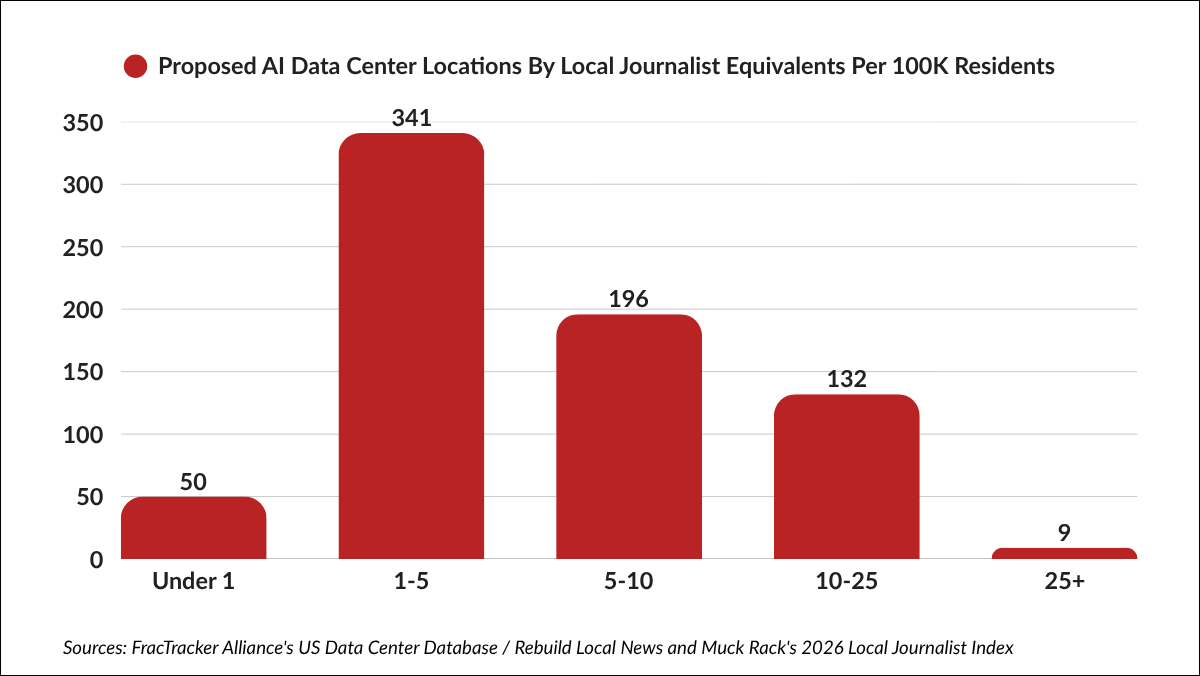
More than half of the pipeline, about 391 of the 728 proposed or under-construction facilities we identified, is located in counties with light news coverage – fewer than five local journalists per 100,000 residents.
The worst counties in terms of coverage also had a disproportionate share of proposed or under-construction data centers. Counties with fewer than one Local Journalist Equivalent (LJE) per 100,000 residents – a barren area – have 59 proposed data centers, about 6% of the total (even those counties make up 3% of population).
At the other end of the spectrum, counties with more journalists are less likely to have data centers. Counties with 10 or more LJEs per 100,000 residents are home to about a quarter of the U.S. population, but account for a smaller share of planned data center projects.
Of course, this is a descriptive snapshot, not evidence that developers choose locations because they lack journalists. Developers are likely drawn to places with relatively cheap land, power, and water, and those conditions are more often found in rural communities where local journalism is already thin. The data also capture a single point in time in a rapidly changing industry, and no public database captures every proposed project.
But it does raise two questions: where data centers are being considered, is there enough good journalism to inform the local discussion? And if a data center is built, will there be enough journalistic capacity to cover the impact and track the promises made by tech companies to the communities.
Data center siting is exactly the kind of consequential local decision that benefits from sustained reporting. Projects can involve complicated regulatory issues including property tax, water permits, land purchases, and utility agreements that may shape a county’s finances and infrastructure for decades. Those decisions can move quickly, sometimes with limited public visibility.
Coverage that has appeared on data centers gives a flavor of the types of reporting that will be needed everywhere.
In Pima County, Arizona, which has 7.1 LJEs per 100,000 residents, records obtained by the nonprofit newsroom Arizona Luminaria revealed Amazon as the hidden user behind “Project Blue.” The reporting helped fuel the city’s rejection of the project and the adoption of new rules governing high-volume water users. The story was reported by Yana Kunichoff, a Report for America corps member.
Consider Edgecombe County, North Carolina, which has fewer than one LJE per 100,000 residents. When a proposed 900-megawatt center drew opposition, reporting from regional and statewide outlets, including WFAE in Charlotte, WUNC in the Triangle and NC Health News, helped bring the plans to public attention. The proposed center was subsequently withdrawn.
When we look at where data centers are canceled alongside levels of reporting, a modest trend appears, though it is fragile. Among the facilities in our dataset, just 6% of those in counties with fewer than one LJE per 100,000 residents had been cancelled. The rate rises with the number of reporters. In counties with five to 25 reporters, cancellation rates rise to between 8-10% and top out at 14% in the most heavily staffed counties, those with 25 or more LJEs. The sample is small, so firm conclusions are hard to draw, and journalists are certainly not causing data centers to be cancelled on their own. There are far too many other factors at work. But the trends still suggest that the presence of reporting capacity appears to coincide with a very different information environment around major development projects.
And that may be the more important story.
America is making enormous investments in the infrastructure of the AI economy, often in small towns and rural counties rather than in established tech hubs like Silicon Valley. The communities receiving that infrastructure are being asked to weigh the benefits against the costs, often with limited independent information.
Residents do not need a reporter to tell them whether they should support a data center. But they do need someone who can find the documents, attend the meetings, identify who is behind a project, follow the negotiations, explain the trade-offs and keep asking questions after the initial announcement has faded from view. As communities weigh what developers owe in return, one idea is to build that accountability into the deal itself. Rebuild Local News president Steven Waldman has proposed that community benefit agreements include funding for independent local journalists.
The AI boom may be creating a new test for local news. The question is whether the communities experiencing the biggest changes will have enough journalists to cover what happens next.

Get the latest on local news legislation, industry developments, and more with our monthly newsletter.