




The Contraction
News organizations
Since 2005, 3,500 newspapers have closed.
Some 1,800 communities that had at least one newspaper now have none.
In 90 percent of these communities that lose a newspaper, no digital-native startup has appeared to fill the gap.
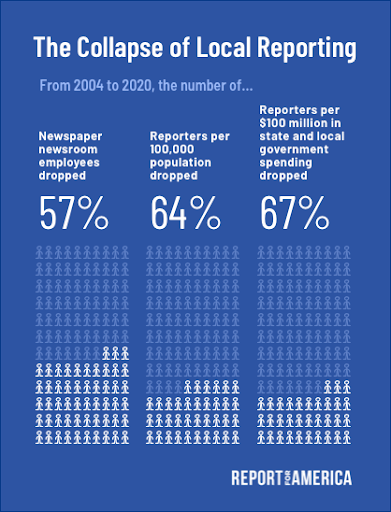
Journalists
The number of local journalists in the U.S. has dropped by more than 75 percent since 2002, according to the Local Journalist Index.
As a result, the number of newspaper newsroom staff per 100,000 population has declined 62 percent, and the number of reporters per $100 million in local government spending has declined 67 percent.
At least another 1,000 that are what is known as “ghost newspapers,” defined as papers that have lost at least half of their staff. Larger newspapers have cut back on coverage of counties outside the city center, and significant beats affecting residents’ lives such as education, health care, and criminal justice.
Lost coverage
One study of 16,000 stories in 100 communities conducted by Duke University’s Phil Napoli, only 17 percent of the content in local newspapers was about local communities and addressed a critical information need. One in five newspapers had no locally-produced journalism at all.
Between 1999 and 2017, coverage of local politics dropped by 56 percent, according to a study of 121 newspapers by Professors Danny Hayes and Jennifer Lawless. “The smallest papers experience the biggest proportional cuts to coverage of local government,” they wrote. “Local coverage was reduced 300 percent more than other topics at the smallest papers but only 30 percent more than at the largest papers.”
This has hurt the ability of Americans to get crucial information about urgent topics affecting their lives, such as education: “One out of every three stories written about school boards in 2003 had disappeared by 2017.”
Again the trend was more alarming in small outlets. “Among those with less than 15,000 circulation, the average reduction in schools’ coverage was 56 percent.”
Americans in these communities have less information to guide their decisions in local elections. “In Boise, Idaho, for example, as mayoral coverage in the Idaho Statesman fell from 7.7 percent (2001) to 3.5 percent (2011) of the news hole, mayoral turnout declined from 24.8 percent to 11.4 percent Remarkably that’s a virtually identical 54 percent drop in both,” according to Hayes and Lawless.
Typically, newspapers that have cut back on local reporting fill more of their pages with national or regional material.
Less trusted information sources
Americans consistently trust local news more than national news. According to Pew Research Center, in 2025 70 percent of U.S. adults said they have at least “some” trust in their local news organizations, far higher than trust in national media which sits at 56 percent.
Local information needs unmet
As a result, more than four out of ten Americans (44%) report difficulty getting information about their own neighborhood in contrast to national news (26%) and international news (30%) according to a Civic Information Needs Census national survey. Across vital subjects ranging from local politics to transportation, a massive gap exists between interest and availability, with a 21 to 46 percentage point deficit between the topics voters deem important and the information they actually receive. Crucially, these unmet needs are not a partisan issue; they transcend politics, demographics, and geography.
Consequences
Lower voter turnout and less choice in candidates
Communities with less local news have lower voting rates. Even historically, communities that gained or retained a local newspaper showed higher voter participation over time. A national study found that adding even a single daily newspaper to a community increased voter turnout by about 0.3 percentage points in national elections, a shift that can translate to tens of thousands of additional voters in a close statewide race.
Those who regularly vote are more likely to follow local news (52 percent of regular local voters, compared to 31 percent of those who do not always vote).
Communities with less local news had fewer contested races
In Cincinnati, after the closure of a city’s second newspaper, the Cincinnati Post, fewer candidates ran for office, “incumbents became more likely to win reelection, and voter turnout and campaign spending fell.” Similar declines in competition and participation appear in other communities following newspaper closures.
Less voter knowledge about candidates
When coverage of local politics declined between 2010 and 2014, one study showed that voters were less likely to know who represented them in Congress or to hold opinions about those officials.
Residents in areas with less local news are less likely to be able to name things they like or dislike about their representative. People in these areas also had less trust in local government and were less confident that their own participation could make a difference.
They are less likely to be able to place their representative on an ideological spectrum.
They had less knowledge about public officials.
They were less likely to seek out additional information about local officials or issues.
In all, the collapse of local news appears to have contributed to a significant drop in the knowledge of local civic affairs in the United States. People in these areas also had less trust in local government and were less confident that their own participation could make a difference.
Less civic engagement in their communities
After the closure of newspapers in Seattle and Denver, there was a significant drop in the likelihood that people would volunteer in civic organizations such as the PTA, the American Legion or a neighborhood watch.
Those who follow local news closely are twice as likely to engage in activities with civic organizations such as sports leagues, church groups or charity organizations’ civic activities.
Americans who have a close attachment to their community are twice as likely to be regular local news consumers as those with minimal attachment. Those who rate local news highly are more likely to speak highly of their communities.
Less well-functioning local government
Where local news fades, governments tend to perform worse.
Communities with less local news had lower bond ratings, higher financing costs, and higher taxes. After a newspaper closes, local governments face higher borrowing costs on average, interest rates rise by 5 to 11 basis points on municipal bonds equivalent to $85 per person per year.
They have more government corruption.
Those districts get less government spending on public benefits.
Areas without local coverage have experienced more public-corruption cases, while their elected officials are less likely to speak up for their districts in Congress.
More polarization
In communities with less local news, voters are more likely to vote on a party line basis, splitting their tickets less frequently. One study found that the loss of a local newspaper reduced split-ticket voting by about two percentage points, a clear sign of greater partisanship.
The members of Congress who get less coverage in the local press are less likely to vote against the party line.
Public health and corporate crime
Communities with less local news are more likely to have more toxic emissions. Factories located near active newspapers produce about 30% fewer toxic emissions than similar facilities without nearby press coverage.
Public health officials say the decline of local news has made it more difficult to track disease outbreaks.
Companies are more likely to have serious regulatory violations including environmental and workplace infractions in communities that have lost local news coverage.