




Local News Shortage Leads to $1.1 Billion in Extra Borrowing Costs for Local Governments and Taxpayers
Building on a landmark municipal bond market study, new analysis puts a price tag on the costs of news deserts to local governments
EXECUTIVE SUMMARY
The widespread decline of local news is not merely a cultural or democratic crisis. It is a major challenge to the fiscal health of state and local governments.
In 2020, finance scholars Pengjie Gao, Chang Lee, and Dermot Murphy demonstrated that the loss of local newspapers leads to higher municipal borrowing costs for local governments, which ultimately trickle down to local residents via higher taxes or reduction in services (Gao, Lee, and Murphy, 2020). Local governments borrow money through the municipal bond market to finance crucial infrastructure such as schools, hospitals, highways, and water systems. These scholars found that these same local governments are more likely to engage in wasteful spending in “news deserts” which have zero newspaper outlets. Municipal bond lenders are more likely to ask for higher interest rates as compensation for the risk of lending to an unmonitored local government that engages in wasteful spending. Confirming this channel, the authors showed that local municipal borrowing costs increase by 5 to 11 basis points after a newspaper closure in an area with already-weak news coverage – an average total interest cost of $650,000 per loan. By contrast, neighboring areas with still-robust news coverage do not see any increase in municipal borrowing costs, thereby ruling out the possibility that deteriorating economic conditions are driving both newspaper closures and higher borrowing costs.
This report follows up on the original research to estimate how much more local governments in news deserts are paying in aggregate at the state and national levels. To arrive at these numbers, we use municipal issuance figures from the Municipal Securities Rulemaking Board (MSRB), state-level estimates of the percentage of the population that lives in a news desert, and a weighted average 8.6 basis point “news desert” borrowing cost premium based on estimates from Gao, Lee, and Murphy (2020).
At the national level, we estimate that local governments in news deserts incur additional borrowing costs of $1.1 billion annually on their outstanding municipal bond issues.
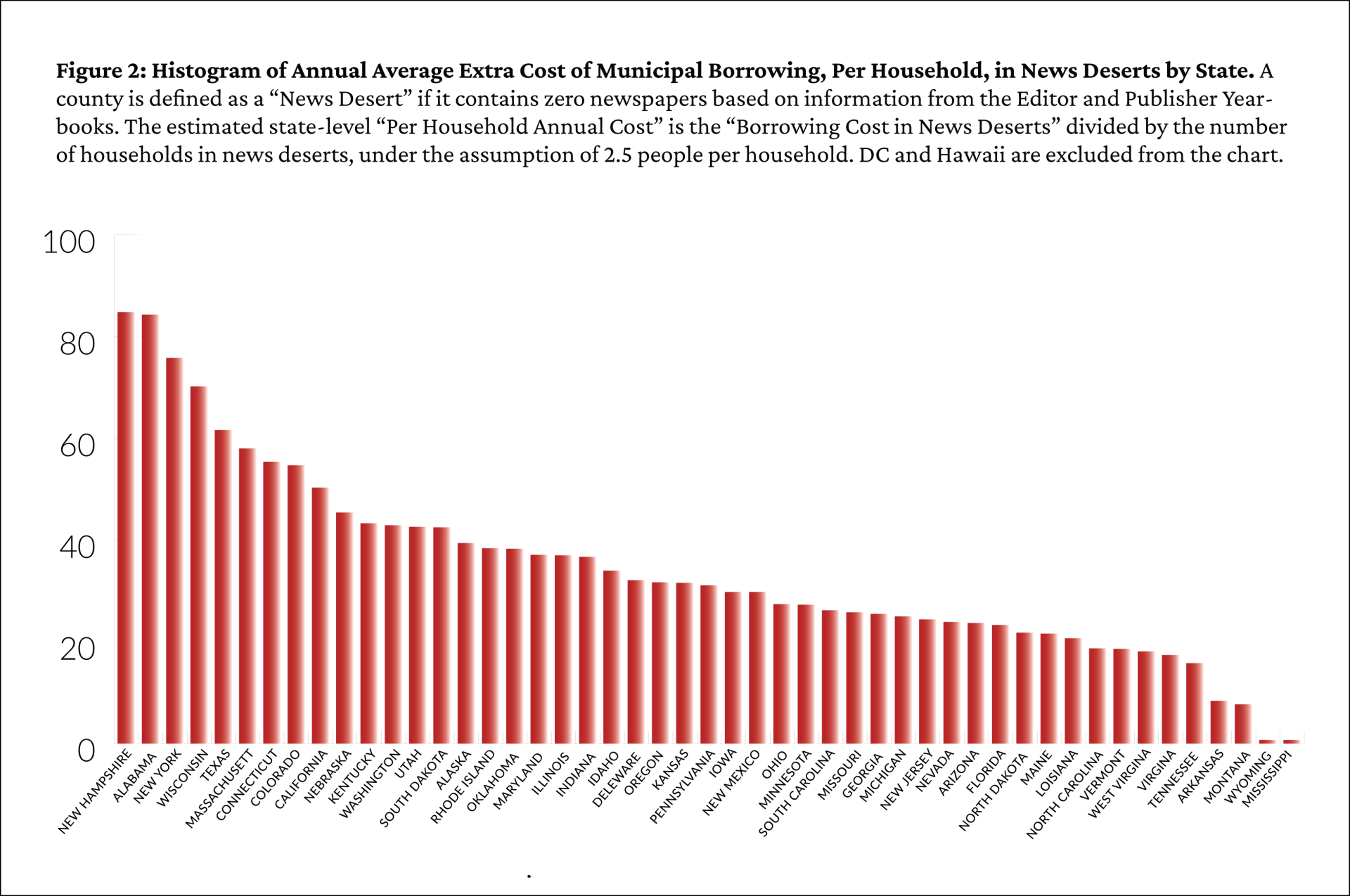
The negative fiscal impact varies by state, depending on both the percentage of the population living in a news desert and the extent to which local governments borrow money through the municipal bond market. With respect to total annual incremental borrowing costs attributable to living in a news desert, the top states are New York ($152 million), Texas, ($132 million), Alabama ($104 million), Georgia ($49 million), and Maryland ($48 million). On a per-household basis, the top states are New Hampshire ($85 per year), Alabama ($84 per year), New York ($76 per year), Wisconsin ($70 per year), and Texas ($62 per year).
The financial figures can be viewed as lower-bound estimates because they do not consider additional costs associated with living in a news desert documented in Gao, Lee, and Murphy (2020) and related studies. These additional costs include higher taxes and government spending (Gao, Lee, and Murphy, 2020), more corruption, financial misconduct, and environmental violations (Matherly and Greenwood (2020); Heese, Pérez-Cavazos, and Peter, 2022; Li, Peng and Zhang, 2025), and lower voter participation and civic engagement (Gentzkow, Shapiro, and Sinkinson, 2011; Hayes and Lawless, 2015; Munevar, Nakhmurina, and Samuels, 2026).
From a policy standpoint, subsidies that support local journalism and reduce the footprint of local news deserts would help to offset the $1.1 billion in annual borrowing costs and the additional costs associated with higher taxes, government spending, and corruption. In the United States, we find that about 2,000 counties are news deserts based on the newspapers listed in the Editor and Publisher yearbooks, the primary data source used in Gao, Lee, and Murphy (2020) to identify and track newspapers. As a point of reference, ambitious legislation introduced in the U.S House of Representatives in 2021 (U.S. House of Representatives, 2021) would have provided subsidies for newsrooms across the country to retain or hire local reporters. Its annual cost was $340 million, about a third of what the country would save if it could get rid of those news deserts and lower municipal rates (Joint Committee on Taxation, 2021).
A more generous program could support 15,000 new reporters at a cost of only $900 million per year, assuming a median salary of approximately $60,000 per year (U.S. Bureau of Labor Statistics, 2025). The support is equivalent to seven to eight journalists per news desert county, on average. If the $900 million subsidy reversed the $1.1 billion in incremental borrowing costs, then the subsidy would generate a return on investment of 22.2%, even without accounting for the additional benefits of robust news coverage in local communities. In sum, this sort of subsidy would not only provide crucial support for the “fourth pillar” of democracy, but would also generate a high return on investment by defraying the costs documented in this report.
Background and Related Literature
Local journalism performs a core fiscal function: continuous, external oversight of public institutions. When that oversight erodes, governments face less scrutiny over spending and procurement decisions, increasing the likelihood of wasteful spending and corruption. For these reasons, bond markets perceive greater risk of lending to unmonitored local governments and thus demand a higher interest rate as compensation for bearing the additional credit risk. The higher borrowing costs for local governments are ultimately borne by local taxpayers in the form of increased taxes and reduced spending on public services and infrastructure upkeep. Data on municipal borrowing costs are available from data providers such as MSRB and Mergent, allowing researchers to quantify the incremental borrowing costs for local governments in news deserts.
The theoretical foundation for this dynamic is based on Prat and Strömberg (2013), who show that a reduction in media coverage directly leads to reductions in public good investment and local government efficiency. A direct implication of this study is that municipalities with weaker press coverage would have higher borrowing costs, as potential lenders recognize the risks associated with lending to an inefficient local government.
Peer-reviewed public finance research provides empirical confirmation of this mechanism. In a 2020 study published in the Journal of Financial Economics, Gao, Lee, and Murphy (2020) find that municipal borrowing costs rise by approximately 5–11 basis points following a newspaper closure in a county that already has weakened newspaper coverage. Critically, this estimate is causal rather than correlational: neighboring counties with similar economic conditions but still-robust news coverage do not experience an increase in borrowing costs. An additional causal test uses the geographic rollout of Craigslist, an early tech platform whose entry into local markets decimated classified advertising revenue and drove newspaper closures, as an instrumental variable for newspaper closures. This variable allows the researchers to isolate the effect of news loss from underlying economic conditions that might independently affect both press viability and municipal borrowing costs. Consistent with the theoretical mechanism in Prat and Strömberg (2013) and the earlier results, the authors find that a Craigslist-induced closure also leads to higher municipal borrowing costs. Lastly, the authors document post-closure patterns consistent with weakened monitoring and greater inefficiency, including increased reliance on opaque bond sales in the negotiated market, a higher likelihood of costly advance refundings, and deterioration in government efficiency metrics.
A complementary line of peer-reviewed research links news loss to greater government inefficiency using publicly-available data on enforcement actions and remediation. In a 2024 study in MIS Quarterly, Matherly and Greenwood (2024) find statistically significant increases in federal public-corruption enforcement activity following the loss of a major daily newspaper, and further find that digital-only substitutes do not replicate the deterrent effect. The increase in enforcement imposes direct fiscal costs on taxpayers through investigations and prosecutions, in addition to any public funds diverted prior to detection. The overall literature points to a consistent conclusion: when routine oversight degrades, local governments are more likely to engage in wasteful spending and corrupt practices, and lenders and regulators respond accordingly.
Beyond municipal bonds, the decline of local journalism creates a significant accountability vacuum that imposes widespread economic costs on both corporate and civic ecosystems. By removing an independent watchdog, newspaper closures degrade the local information environment. This transparency deficit leads to a documented 1.1% rise in corporate regulatory infractions and a 15.2% jump in environmental violations as firms exploit reduced oversight (Heese, Pérez-Cavazos, and Peter, 2022). These distortions can also disrupt entire supply chains, causing geographically distant suppliers to make less efficient investment decisions due to fragmented client data (Le and Trinh, 2025).
The resulting opacity fundamentally alters capital markets: non-local institutional investors routinely divest from affected areas due to heightened uncertainty (Kang, 2025), while banks and corporate lenders price this localized risk by enforcing stricter covenants and raising borrowing spreads by roughly 30 basis points (Ma, Stice, Stice and Zhang, 2025). Ultimately, these compounding financial penalties filter down to the household level, where residents in news-depleted communities face elevated mortgage costs, higher loan denial rates, and greater exposure to financial misconduct (Huyhn, 2025; Bäker, Riepe, and Wulff, 2024; Li, Peng and Zhang, 2025).
Together, this body of research demonstrates that local media serves as a vital public good that reduces borrowing costs, fosters capital formation, and protects ordinary consumers.
The stakes of this watchdog function are not abstract. The Youngstown Vindicator, a 150-year-old daily that closed in 2019, had spent decades exposing organized crime and public corruption, contributing to dozens of convictions. Its absence removed a check that no internal control replaced (Schultze, 2019). Where we have documented post-closure data, the costs are concrete. In Bell, California, a low-income, predominantly Latino community of approximately 36,000 people in Los Angeles County, city officials spent years raising their own pay with almost no public scrutiny. By the late 2000s, the city manager was earning $787,637 a year, the police chief $457,000, and city council members nearly $100,000 for what was officially part-time work (Gottlieb & Vives, 2010; Stoltze, 2010). All of these raises were approved at public municipal meetings that lacked robust newspaper coverage. The Los Angeles Times eventually exposed the arrangement in 2010 after reporters requested salary contracts directly (Gottlieb & Vives, 2010). Eight officials were charged, and prosecutors accused them of misappropriating at least $5.5 million from a city where a quarter of residents lived below the poverty line (Kamlet, 2010). Most were convicted. The city manager received a twelve-year prison sentence (Neuman, 2014). Ruben Vives, one of the Times reporters who broke the story, was direct about how it had gone on so long: “Someone would have got wind of this earlier had there been a reporter there. This is just a prime example of when you turn away, and you let something like this just kind of grow and grow, and it becomes sort of a cesspool of corruption” (Garfield, 2014). The city manager’s salary had started at $72,000 when he was hired in 1993 (Noyes & Lloyd, 2010). It took seventeen years, and the absence of any routine press coverage, for it to reach more than ten times that figure.
Harvey, Illinois offers a documented case study in the costs associated with a sustained absence of local news. The city, a predominantly Black suburb of Chicago with a high poverty rate, had operated until relatively recently without a dedicated local newspaper for decades. With no press present to monitor public meetings or city finances, officials issued municipal bonds between 2008 and 2010 under false pretenses, diverting at least $1.7 million intended for a hotel development project into general city operations while the comptroller received approximately $269,000 in undisclosed payments. The SEC intervened by emergency court order (U.S. SEC, 2014) The mayor settled fraud charges and was permanently barred from future bond activity. Compounding the problem, the city had ceased conducting the annual independent audits required by state law, and key financial records were absent. In 2025, Harvey was $164 million in debt and had reduced its public safety workforce by around 40% to meet debt obligations (Doyle, 2025), and became only the second Illinois municipality in modern history to seek state oversight as a financially distressed city (Shea, 2025); a request the Illinois Department of Revenue ultimately rejected in February 2026 (Wall, 2026). In 2021, a Harvey resident founded the Harvey World Herald after finding it nearly impossible to get basic information about what was happening in the city (Harvey World Herald, 2026).
Analysis and Main Findings
To estimate the fiscal cost of local news deserts on municipal borrowing costs, we combine county-level population data from the U.S. Census, state-level municipal bond issuance figures from the MSRB, and a conservative 8.6 basis point borrowing cost “news desert” premium derived from Gao, Lee, and Murphy (2020). In their paper, they estimate a 5 basis point news desert premium for general obligation bonds (those backed by the tax revenues of the municipality) and an 11 basis point premium for revenue bonds (those backed by the revenues generated by the specific infrastructure project). General obligation bonds comprise about 40% of issuance volume, while revenue bonds comprise the remaining 60%. Therefore, the 8.6 basis point estimate is calculated as the weighted average of the borrowing cost premia for these two types of bonds (40% x 5 basis points + 60% x 11 basis points = 8.6 basis points).
Next, we calculate the percentage of the state population who live in a news desert. We use the original data from Gao, Lee and Murphy (2020) to calculate the percentage of the state population that lives in a county with no local newspaper (a news desert). The data on newspaper closures from Gao, Lee, and Murphy (2020) is based on newspapers from the Editor and Publisher Yearbook almanacs, and thus reflect newspapers that have reasonably large circulation numbers and are more likely to have the capacity to monitor local governments if they are present in the community.
We then obtain the state-level municipal bond issuance figures from the Municipal Securities Rulemaking Board’s Municipal Market Facts report (MSRB, 2026), which provides 2025 issuance totals by state. To estimate the portion of each state’s municipal bond issuance volume in 2025 that is attributable to news desert counties, we multiply the total state issuance volume in 2025 by the state-level percentage of the population that lives in a news desert, under the assumption that bond issuance volume scales proportionally with population within a state. As an illustrative example, Colorado has a population of 6.01 million people, and approximately 31.5% of the population lives in a news desert. Colorado issued $13.89 billion of municipal bonds in 2025, and thus we estimate that $13.89 billion x 31.5% = $4.4 billion was issued in a news desert in 2025.
We apply the 8.6 basis point news desert premium to the state-level estimates of Total Outstanding Issuance Volume to determine the incremental borrowing costs that local governments in news deserts pay per year. A municipal bond has an average maturity of approximately 11 years; under the assumption that a municipality issues the same volume of bonds every year on average, we estimate Total Outstanding Issuance Volume as 2025 Issuance Volume x 11 years. Intuitively, Total Outstanding Issuance Volume represents outstanding issues in 2025 plus those from the previous ten years, as the government is still paying interest on these yet-to-mature bonds. In the case of Colorado, because $4.38 billion was issued in a news desert in 2025, we assume that the state has $4.38 billion x 11 years = $48.2 billion in total outstanding issues in news deserts. We estimate that local governments in news deserts in Colorado therefore pay $48.2 billion x 8.6 basis points = $41.5 million in total incremental borrowing cost per year.
Lastly, we should note that Total Outstanding Issuance Volume and the total incremental borrowing cost per year will partially reflect the size of the state. In New York and Texas, for example, issuance volumes are generally higher because these states have larger populations; therefore, total incremental borrowing costs will also be higher compared to smaller states with a similar news desert makeup. To address this size issue, we also calculate for each state the annual cost per household by dividing the incremental borrowing cost by the number of households in news deserts (i.e., the total population in news deserts divided by 2.5, the average number of people per household). In the case of Colorado, the number of households in news deserts is 1.896 million / 2.5 = 0.758 million, and thus the per household cost burden is $41.5 million / 0.758 million = $54.7 per year.
Table 1 provides a state-level summary of the percentage of the population that lives in a news desert, the estimated municipal bond issuance volume in news deserts in 2025, the estimated total incremental borrowing costs in news deserts per year, and the estimated per household annual cost in news deserts. In the last row of this table, we also provide the same statistics for the United States as a whole.
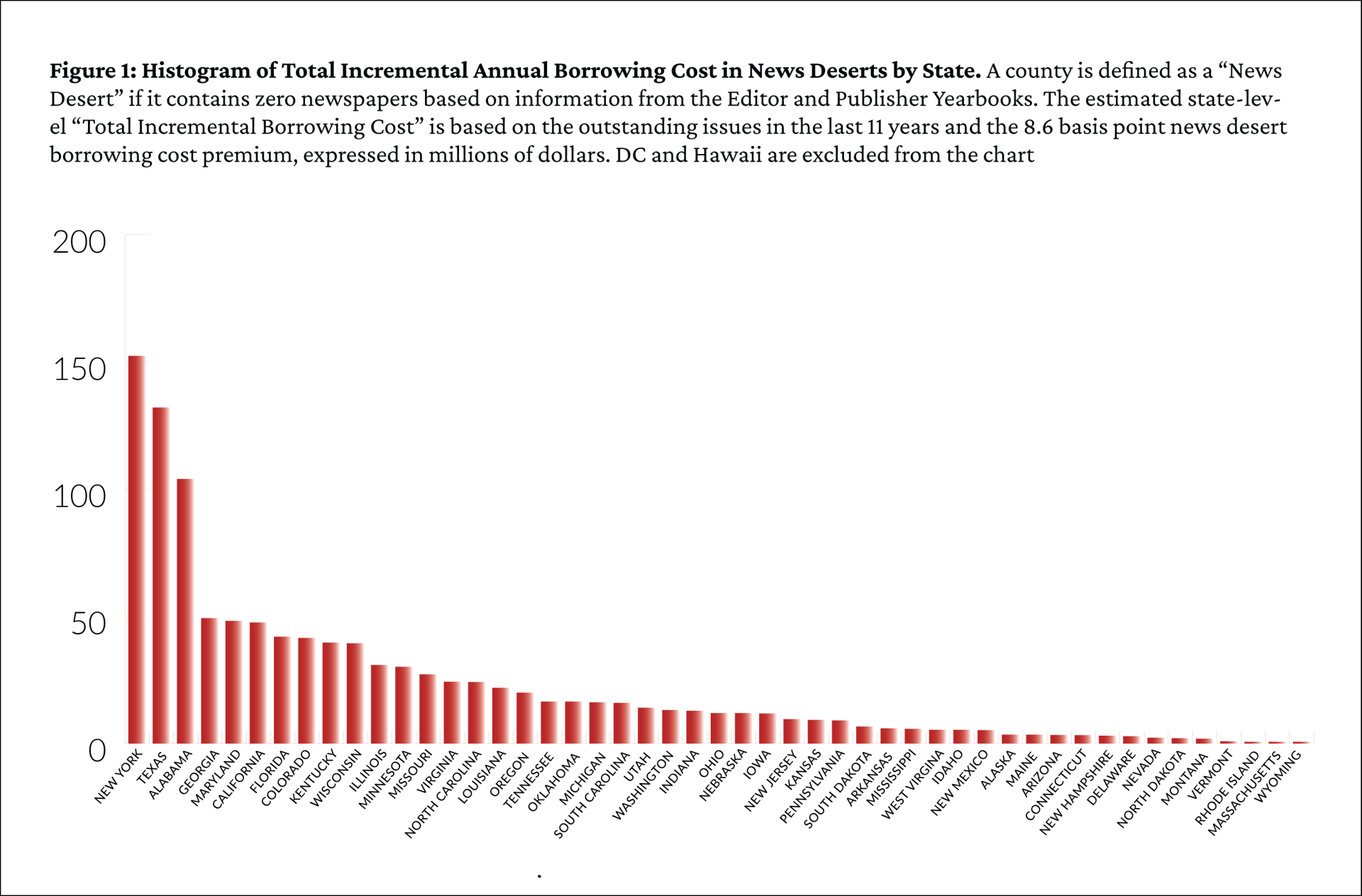
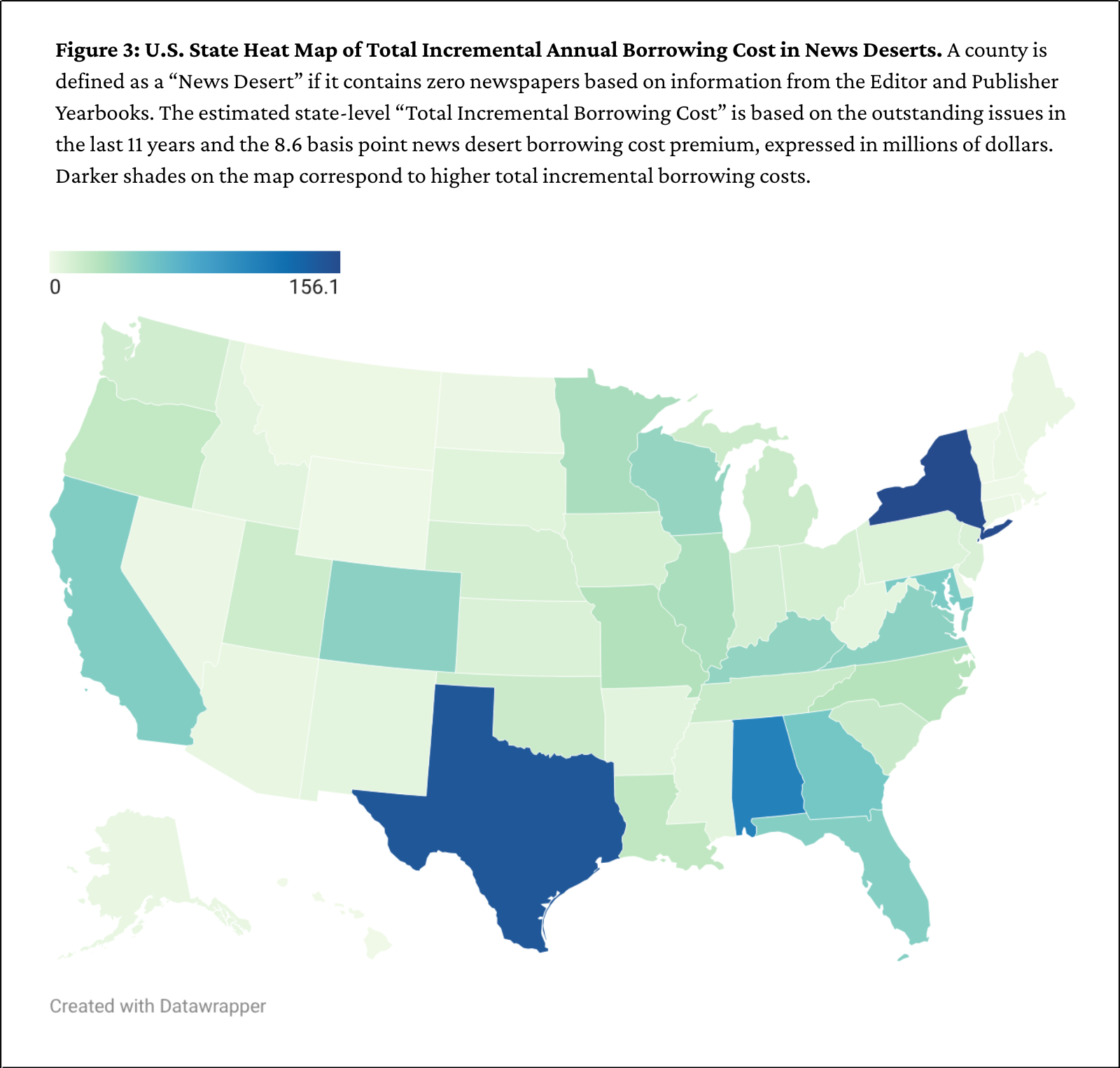
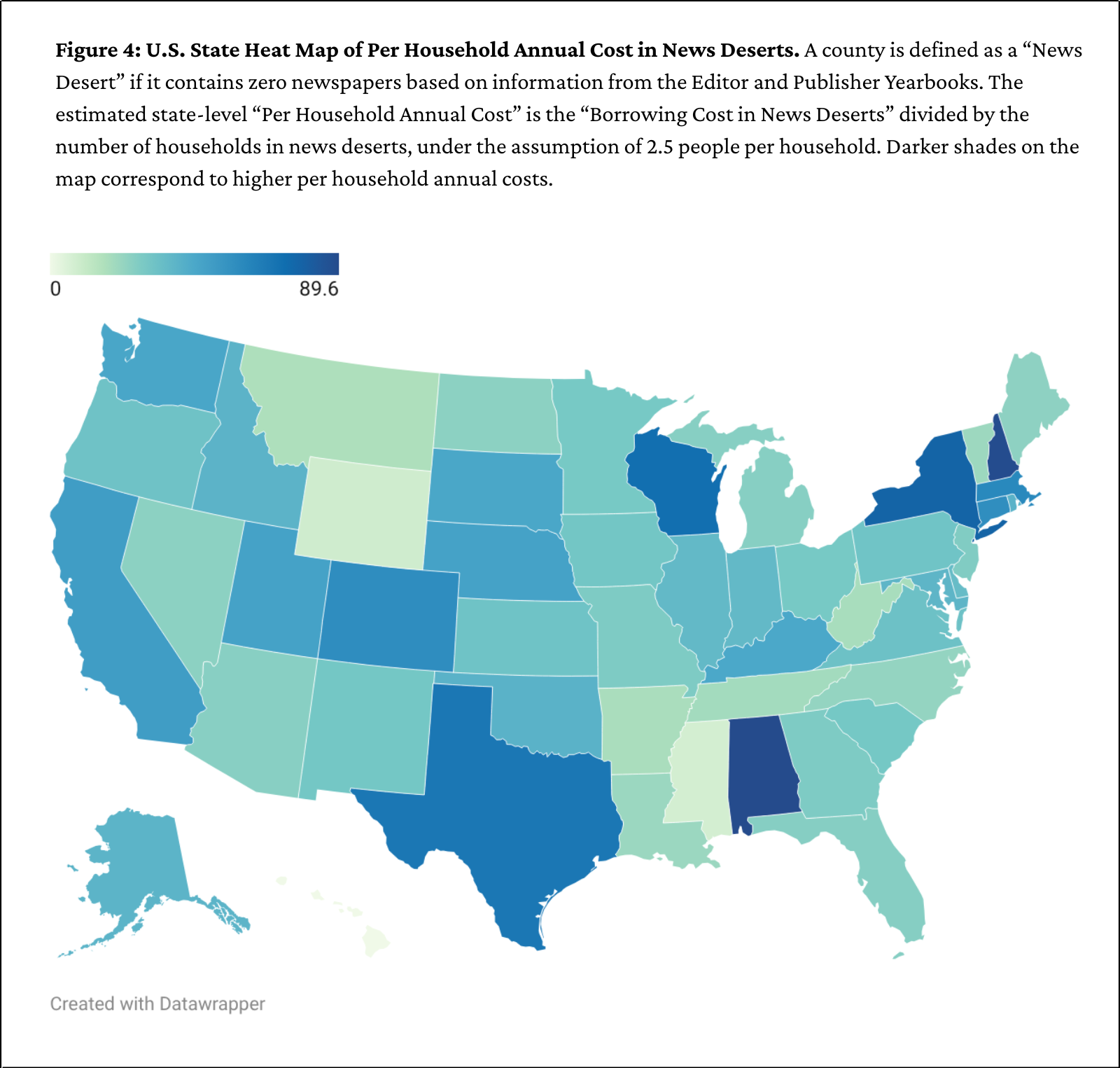
In the United States, 21.2% of the population lives in a news desert; within these news deserts, the total incremental borrowing cost is $1.1 billion per year, and the associated per household cost burden is $38 per year. For analytical convenience, Figures 1 and 2 provide an overview of the total annual borrowing costs and the associated per-household annual costs of living in a news desert at the state level based on the data from Table 1.
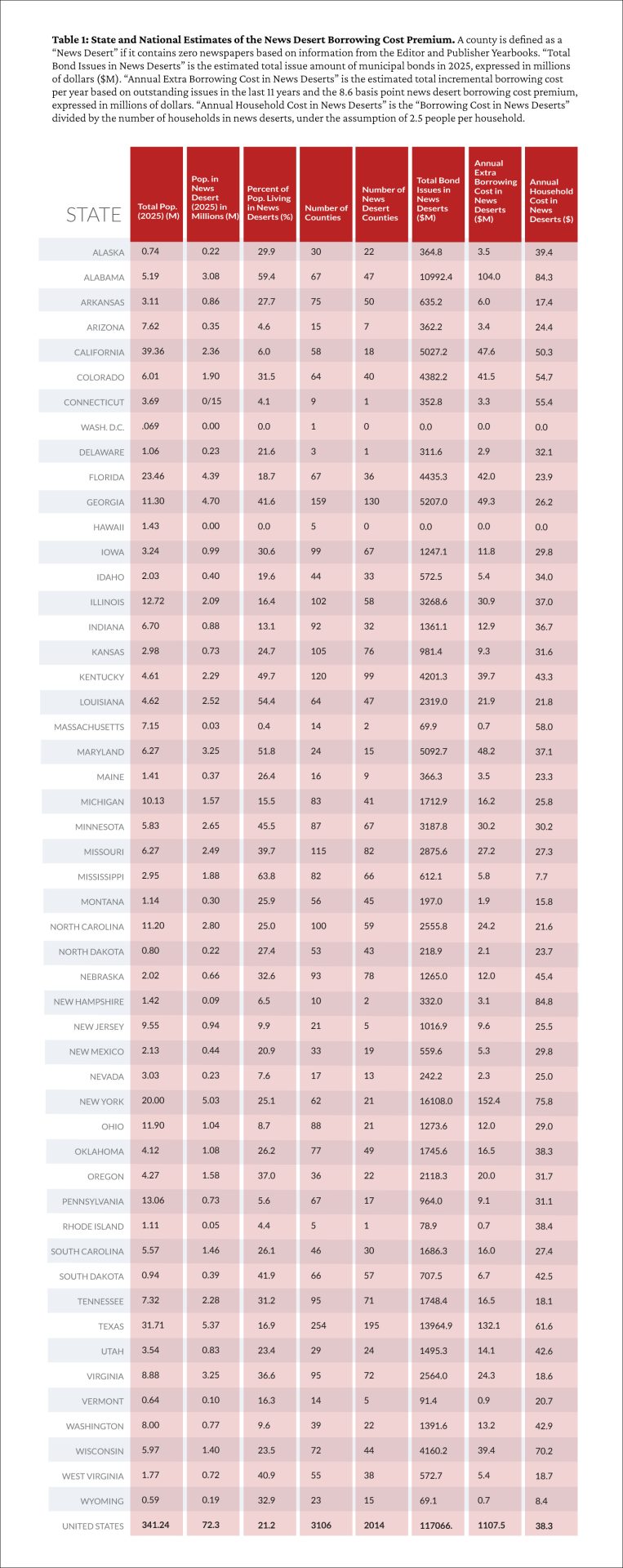
Table 2 provides a ranking of the top ten states by the annual extra borrowing cost in news deserts. The top five states by total incremental borrowing cost are New York ($152 million), Texas, ($132 million), Alabama ($104 million), Georgia ($49 million), and Maryland ($48 million). These states tend to borrow larger quantities from the municipal bond market, and also tend to have larger news desert footprints, thereby explaining the larger incremental borrowing costs.
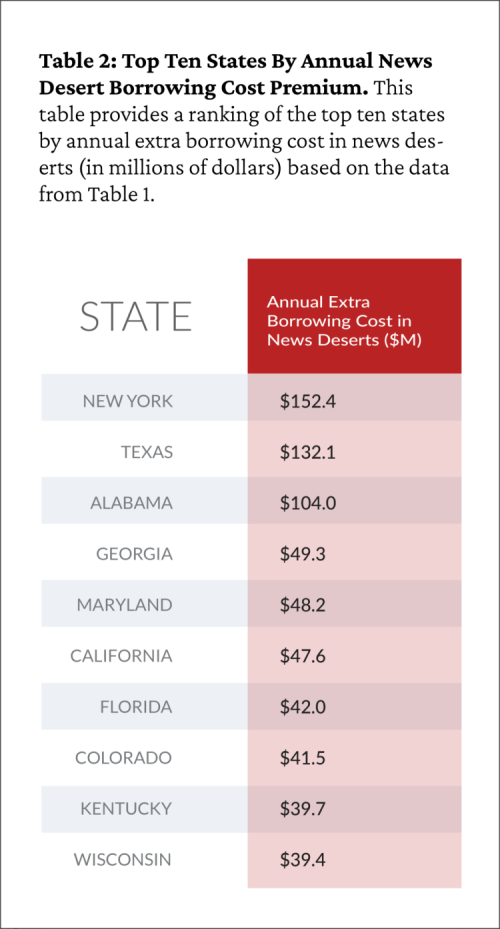
Table 3 provides a ranking of the top ten states by the annual per household cost in news deserts. By focusing on the per household cost, we effectively control for the population size of the state. Notably, we find that the cost of living in a news desert is not just a big state problem: the top five states based on annual household cost in news deserts are New Hampshire ($85 per year), Alabama ($84 per year), New York ($76 per year), Wisconsin ($70 per year), and Texas ($62 per year). By contrast, states with a low news desert footprint such as Arizona and Pennsylvania have relatively low total incremental annual borrowing costs and per household annual cost.
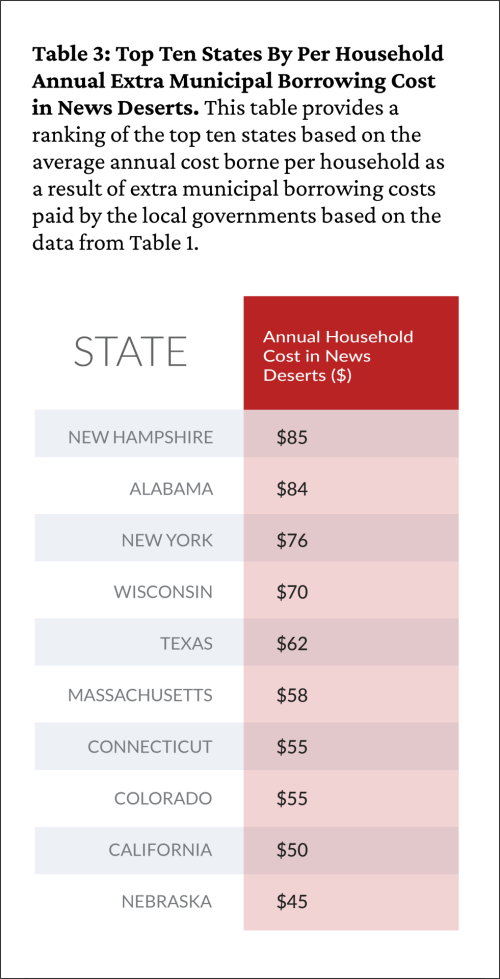
Figure 3 provides a U.S. geographic heat map of the total incremental annual borrowing costs. This figure indicates that total incremental annual borrowing costs are larger in high-population states such as New York, Texas, and California, which is not surprising given that they issue more and larger bonds. However, the same figure indicates that many mid-sized states such as Alabama, Maryland, and Kentucky also have high total incremental annual borrowing costs due to a combination of a fairly sizable news desert footprint (59.4%, 51.8%, and 49.7%, respectively), and high borrowing activity in the municipal bond market ($11.0 billion, $5.1 billion, and $4.2 billion, respectively).
Figure 4 provides a U.S. geographic heat map of the per household annual cost, a standardized measure that is independent of the size of the state. We find that the highest per household annual costs are well-distributed across geographies, with notable states including the aforementioned New Hampshire, Alabama, New York, Wisconsin, and Texas. In the case of New Hampshire, because a small percentage of the population lives in a news desert, the total cost burden is not significantly large, even if the cost burden per household appears large. However, for the remaining four states, the news desert population is sizable, and thus the per household annual cost also translates to significant costs for the state. Policymakers should consider both the total annual borrowing cost and the per household annual cost metrics for the purposes of issuing policy prescriptions on where journalism investments or subsidies would generate the greatest value for local communities.
Lastly, we should note that the analysis rests on several simplifying assumptions. First, bond issuance is assumed to scale proportionally with population within states, meaning that a county containing 30% of a state’s population is treated as responsible for 30% of its issuance, a reasonable approximation on average, but one that does not account for variation in local government borrowing activity. Second, the 8.6 basis point premium is applied uniformly across all bond types, maturities, and issue sizes, whereas in practice the penalty may vary depending on issue characteristics. For example, Gao, Lee and Murphy (2020) find that the borrowing costs for general obligation bonds were less impacted than those for revenue bonds, on average. Third, the analysis also treats 2025 issuance activity as representative of previous and ongoing annual borrowing, though issuance volumes fluctuate year to year. However, the measurement issues associated with these simplifying assumptions are unlikely to significantly affect our inferences because we mainly focus on aggregate estimates.
We should also note that the “news desert” classification is based on newspaper data from Gao, Lee and Murphy (2020), which means that the news desert classification in this report reflects conditions from roughly a decade ago. Therefore, this analysis likely understates the true cost of local news loss, in that it excludes partial newsroom degradation, areas with understaffed newspapers that do not effectively monitor local governments, the collapse of non-newspaper local media, and long-term compounding effects. On the other hand, the analysis might overestimate the effect if digital local outlets are able to substitute the watchdog role of a local newspaper. While the original analysis in Gao, Lee and Murphy (2020) provides evidence that online news media do not act as a perfect substitute for local newspapers, it is possible that digital news outlets have since sufficiently evolved to act as a sufficient watchdog for local governments. A growing number of digital-native and nonprofit outlets have emerged with an explicit government accountability mission, among them Spotlight PA in Pennsylvania, The Texas Tribune, VTDigger in Vermont, Mississippi Today, CalMatters, and The Nevada Independent. Future studies may want to examine the potential evolution of digital news outlets as monitors for local governments, and how the presence of digital news outlets affects municipal borrowing costs when no traditional newspaper outlet is present.
Concluding Discussion and Policy Implications
When viewed through a fiscal lens, public investment in local journalism can lead to significant cost savings for local governments and taxpayers. Gao, Lee, and Murphy (2020) show that communities that lose their local newspapers face measurable increases in municipal borrowing costs, driven by reduced oversight and a market-driven perception of greater local government corruption and inefficiency. The logic for offsetting these costs is straightforward: stabilizing local watchdog reporting can produce measurable public benefits by reducing borrowing costs and recovering dollars otherwise lost to higher borrowing costs.
Note that the borrowing costs are not the only way that local news saves local governments money. For example, governments routinely collect billions of dollars in fines from companies based on evidence first provided by journalists (Hamilton, 2016; Heese et al, 2022) Additional reports have shown that areas with more local news have greater economic activity and therefore more tax revenue (Parker Phillips, 2021; BJH Advisors, 2022).
We also know that the true economic cost associated with a lack of local news coverage is likely higher than what is documented in this report. The estimates in this report rely on local news deserts with zero local newspapers. However, many communities only have small newspaper operations that are significantly understaffed due to operational pressures or budget cuts from their parent companies. A community with one surviving newspaper and two reporters covering everything from sports to school board meetings may offer little more meaningful oversight than a community with none. The findings in Gao, Lee, and Murphy (2020) indicate that these communities will face higher borrowing costs as well.
Local newspapers perform a crucial watchdog role, preventing government malfeasance and corruption. What actually protects taxpayers is not whether a local paper exists in name, but whether there are working reporters with the time and resources to cover city hall, school boards, and local spending. A community that technically has a local outlet but only a skeleton staff could be just as exposed to the kinds of government waste and inefficiency that drive up borrowing costs. That means the policy case for supporting local journalism extends beyond communities that have lost all their news coverage; it applies anywhere that reporter capacity has shrunk to the point where meaningful oversight is no longer possible. Investments in journalism will deliver the greatest fiscal return where they are targeted first at the most at-risk communities, but the broader argument for keeping working journalists in local newsrooms holds across a much wider range of places than the desert label alone captures. Improving coverage throughout a state, not just in news deserts, would therefore likely reduce government costs more broadly as well.
The question for state policymakers is not whether journalism investment pays off — this report shows that it does, most clearly in the form of lower borrowing costs for local governments, and likely across other areas of public spending as well. The deeper question is whether states are willing to keep paying the additional costs embedded in a system where some residents get less accountability coverage than those in other communities. The evidence indicates that the costs associated with the loss of local news are real and measurable, and ones that states cannot afford to ignore.
About the Authors
Matthew Baker is the Director of Research at Rebuild Local News. He previously served as a Senior Advisor at the U.S. Agency for International Development, where he managed research and evaluation projects to strengthen independent media in struggling democracies around the world. Previously, he conducted focus groups, surveys, data visualizations, and statistical analysis at the International Republican Institute, Dexis Consulting, and the Legatum Institute.
Dr. Dermot Murphy is an Associate Professor of Finance at the University of Illinois Chicago (UIC) College of Business Administration. His research bridges the complex mechanics of market microstructure with the real-world economic realities of public finance. Dr. Murphy has built a distinct academic footprint by examining how information ecosystems—ranging from high-frequency algorithmic trading desks to local municipal newspapers—directly impact market liquidity, asset pricing, and government borrowing costs.
Appendix
Bibliography
- Amiri, Farnoush and Arbel, Tali “Biden Bill Would Give Local News Outlets ‘Shot in the Arm,'” Associated Press, November 13, 2021. https://apnews.com/article/joe-biden-business-congress-newspapers-television-604ecdbc81b21c3876ef08d25ebccac4
- Ang, A., Bhansali, V., & Xing, Y. (2014). “The Muni Bond Spread: Credit, Liquidity, and Tax.” Unpublished working paper, Columbia University. https://papers.ssrn.com/sol3/papers.cfm?abstract_id=2489190
- Ang, A., Green, R. C., Longstaff, F. A., & Xing, Y. (2017). “Advance Refundings of Municipal Bonds.” Journal of Finance, 72(4), 1645–1682. https://onlinelibrary.wiley.com/doi/abs/10.1111/jofi.12506
- Bäker, A., Riepe, J., & Wulff, A. (2024). “Local Newspaper Closures and Their Effect on Lending Discrimination.” TRR 266 Accounting for Transparency Working Paper Series No. 195. SSRN. https://ssrn.com/abstract=5319025
- BJH Advisors (2022). New York City Publishing Industry Economic Impact Study. NYC Mayor’s Office of Media and Entertainment. https://www.nyc.gov/assets/mome/pdf/NYC-Publishing-Industry-Economic-Impact-Study.pdf
- Butler, A. W., Fauver, L., & Mortal, S. (2009). “Corruption, Political Connections, and Municipal Finance.” Review of Financial Studies, 22(7), 2673–2705. https://www.jstor.org/stable/40247690
- Campante, F. R., & Do, Q.-A. (2014). “Isolated Capital Cities, Accountability, and Corruption: Evidence from US States.” American Economic Review, 104(8), 2456–2481. https://www.aeaweb.org/articles?id=10.1257/aer.104.8.2456
- Civic Information Needs Census. (2026). Insights. https://infocensus.org/insights
Dyck, A., Morse, A., & Zingales, L. (2010). “Who Blows the Whistle on Corporate Fraud?” Journal of Finance, 65(6), 2213–2253. https://onlinelibrary.wiley.com/doi/10.1111/j.1540-6261.2010.01614.x - Doyle, T. (2025). “City of Harvey Furloughs 69 Employees Amid Severe Financial Emergency.” FOX 32 Chicago. https://www.fox32chicago.com/news/city-harvey-furloughs-69-employees-amid-severe-financial-emergency
- Garfield, B. (Host). (2014, December 26). “The Cautionary Tale of Bell, California.” On the Media. WNYC Studios. https://www.wnycstudios.org/podcasts/otm/segments/cautionary-tale-bell-californias
- Gao, P., Lee, C., & Murphy, D. (2020). “Financing Dies in Darkness? The Impact of Newspaper Closures on Public Finance.” Journal of Financial Economics, 135(2), 445–467. https://doi.org/10.1016/j.jfineco.2019.06.003
- Gentzkow, M., Shapiro, J. M., & Sinkinson, M. (2011). “The Effect of Newspaper Entry and Exit on Electoral Politics.” American Economic Review, 101(7), 2980–3018. https://www.aeaweb.org/articles?id=10.1257/aer.101.7.2980
- Gentzkow, M., Shapiro, J. M., & Sinkinson, M. (2014). “Competition and Ideological Diversity: Historical Evidence from US Newspapers.” American Economic Review, 104(10), 3073–3114. https://www.aeaweb.org/articles?id=10.1257/aer.104.10.3073
Gottlieb, J., & Vives, R. (2010). “Is a City Manager Worth $800,000?” Los Angeles Times, July 15, 2010. https://www.latimes.com/local/la-me-bell-salary-20100715-story.html - Hamilton, J. T. (2016). Democracy’s Detectives: The Economics of Investigative Journalism. Harvard University Press.
- Harvey World Herald. (2026). “About.” Harvey World Herald. https://harveyworld.org/about/
- Heese, J., Pérez-Cavazos, G., & Peter, C. D. (2022). “When the Local Newspaper Leaves Town: The Effects of Local Newspaper Closures on Corporate Misconduct.” Journal of Financial Economics, 145(2), 445–463. https://doi.org/10.1016/j.jfineco.2021.08.015
- Huynh, T. (2025). “Lending in the Dark: Local Newspaper Closures and Discrimination in Mortgage Lending.” Jena Economics Research Papers No. 2025-002. https://oweb.b67.uni-jena.de/Papers/jerp2023/wp_2025_002.pdf
- Joint Committee on Taxation, Estimated Budget Effects of the Revenue Provisions of Title XIII of H.R. 5376, the “Build Back Better Act” (JCX-45-21), November 4, 2021.
- Kang, J., & Nam, Y. (2025). “Do Local Newspapers Matter to Institutional Investors?” Contemporary Accounting Research. https://doi.org/10.1111/1911-3846.13049
- Kamlet, Lee, “Bell, Calif., City Leaders Arrested in Salary Scandal,” ABC News, Sept. 21, 2010. https://abcnews.go.com/US/bell-calif-city-leaders-arrested-salary-scandal/story?id=11691192
- Le, T. L. D., & Trinh, T. (2025). “Local Newspaper Closures and Suppliers’ Investment Efficiency.” European Journal of Finance, 31(12), 1529–1550. https://doi.org/10.1080/1351847X.2025.2513500
- Li, Z., Peng, Q., & Zhang, R.-Z. (2025). “When Spotlights Fade: Local Newspaper Closures and Financial Advisor Misconduct.” Journal of Financial and Quantitative Analysis. https://doi.org/10.1017/S0022109025101749
- Ma, Z., Stice, D., Stice, H., & Zhang, Y. (2025). “Local Newspaper Closures and Bank Loan Contracts.” Contemporary Accounting Research. https://doi.org/10.1111/1911-3846.13046
- Matherly, T., & Greenwood, B. N. (2024). “No News is Bad News: The Internet, Corruption, and the Decline of the Fourth Estate.” MIS Quarterly, 48(2), 699–714. https://doi.org/10.25300/MISQ/2023/17869
- Muck Rack and Rebuild Local News. (2025). The Local Journalist Index. http://localjournalistindex.com
- Municipal Securities Rulemaking Board (MSRB). (2026). Municipal Market Facts: 2025 Annual Data Report. https://www.msrb.org/sites/default/files/2022-09/MSRB-Muni-Facts.pdf
- Nakhmurina, A., Munevar, K., & Samuels, D. (2026). “Removing Government Notices from Newspapers Reduces Citizen Participation in Decision-Making.” Yale Insights, Yale School of Management. https://insights.som.yale.edu/insights/removing-government-notices-from-newspapers-reduces-citizen-participation-in-decision
- Neuman, S. (2014, April 16). “Ex-City Manager Caught in Calif. Salary Scandal Gets 12 Years.” NPR: The Two-Way. https://www.npr.org/sections/thetwo-way/2014/04/16/303768753/ex-city-manager-caught-in-calif-salary-scandal-gets-12-years
- Northwestern University Medill School. (2025). The State of Local News Report. Medill Local News Initiative. https://localnewsinitiative.northwestern.edu/assets/slnp/the_state_of_local_news_2025.pdf
- Novy-Marx, R., & Rauh, J. D. (2012). “Fiscal Imbalances and Borrowing Costs: Evidence from State Investment Losses.” American Economic Journal: Economic Policy, 4(2), 182–213. https://www.aeaweb.org/articles?id=10.1257/pol.4.2.182
- Noyes, J., & Lloyd, J. (2010). “Three Resign Over Bell Salary Scandal.” NBC Los Angeles, July 22, 2010. https://www.nbclosangeles.com/news/local/city-seeks-resignations-of-high-paid-officials/1878777/
- Parker Philips. (2021). Pennsylvania’s Newspaper Industry Makes a Significant Impact. Pennsylvania NewsMedia Association. https://panewsmedia.org/wp-content/uploads/Legal_and_Legislative/Economic_Impact_Report/Pennsylvania-News-Media-Economic-Impact-Report.pdf
- Peress, J. (2014). “The Media and the Diffusion of Information in Financial Markets: Evidence from Newspaper Strikes.” Journal of Finance, 69(5), 2007–2043. https://onlinelibrary.wiley.com/doi/abs/10.1111/jofi.12179
- Pew Research Center. (2017). “Newspapers Fact Sheet.” http://www.journalism.org/fact-sheet/newspapers/
- Prat, A., & Strömberg, D. (2013). “The Political Economy of Mass Media.” In D. Acemoglu, M. Arellano, & E. Dekel (Eds.), Advances in Economics and Econometrics: Theory and Applications, Tenth World Congress (Vol. 2, pp. 135–187). Cambridge University Press. https://www.columbia.edu/~ap3116/papers/mediasurvey11.pdf
- Rebuild Local News. (2026). Research on Local News Crisis and The Case for Local News Tax Credit. https://www.rebuildlocalnews.org/solutions/payroll-tax-credit/
- Schultze, M. L. (2019). “After 150 Years Serving Youngstown’s Community, ‘The Vindicator’ Will Stop Publishing.” NPR. https://www.npr.org/2019/08/30/756034734/after-150-years-serving-youngstowns-community-the-vindicator-will-stop-publishin
- Stoltze, F. (2010). “Calif. City Officials Resign Over Outrage at Salaries.” NPR, July 23, 2010. https://www.npr.org/transcripts/128725689
- Schulhofer-Wohl, S., & Garrido, M. (2009). “Do Newspapers Matter? Short-Run and Long-Run Evidence from the Closure of The Cincinnati Post.” Unpublished working paper, National Bureau of Economic Research. https://www.nber.org/system/files/working_papers/w14817/w14817.pdf
- Shea, J. (2025). “Harvey, Illinois Declares Itself Financially Distressed.” Bond Buyer. https://www.bondbuyer.com/news/harvey-illinois-declares-itself-financially-distressed
- Snyder, J. M., & Strömberg, D. (2010). “Press Coverage and Political Accountability.” Journal of Political Economy, 118(2), 355–408. https://www.journals.uchicago.edu/doi/abs/10.1086/652903
- Syracuse University and Rebuild Local News. (2026). Local News Research Hub. https://www.localnewsresearchhub.com/
- U.S. Securities and Exchange Commission. (2014). “SEC Obtains Court Order to Halt Fraudulent Bond Offering by City of Harvey, Ill.” SEC Press Release No. 2014-122. https://www.sec.gov/news/press-release/2014-122
- U.S. Bureau of Labor Statistics, Occupational Outlook Handbook: News Analysts, Reporters, and Journalists, last modified August 28, 2025. https://www.bls.gov/ooh/media-and-communication/reporters-correspondents-and-broadcast-news-analysts.htm
- U.S. House of Representatives, H.R.5376, Local Journalism Sustainability Act, H.R. 3940, 117th Cong. (2021). https://www.congress.gov/bill/117th-congress/house-bill/3940
- Wall, Craig, “Illinois Denies Request for Harvey to Be Declared ‘Financially Distressed’ City,” ABC7 Chicago, Apr. 4, 2026. https://abc7chicago.com/post/state-illinois-department-revenue-denies-request-city-harvey-declared-financially-distressed/18837394/
- WGN-TV. (2025). “Harvey Financial Distress Layoffs: Firefighters Among Those Cut.” WGN-TV. https://wgntv.com/news/south-suburbs/harvey-financial-distress-layoffs-firefighters/

Get the latest on local news legislation, industry developments, and more with our monthly newsletter.