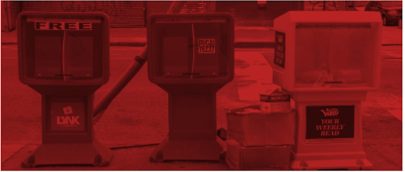




New National Hub Unifies Research on the Local News Crisis and Paths to Recovery
Developed by Syracuse University and Rebuild Local News, the Local News Research Hub brings together interdisciplinary research on the causes, consequences and remedies of local news decline
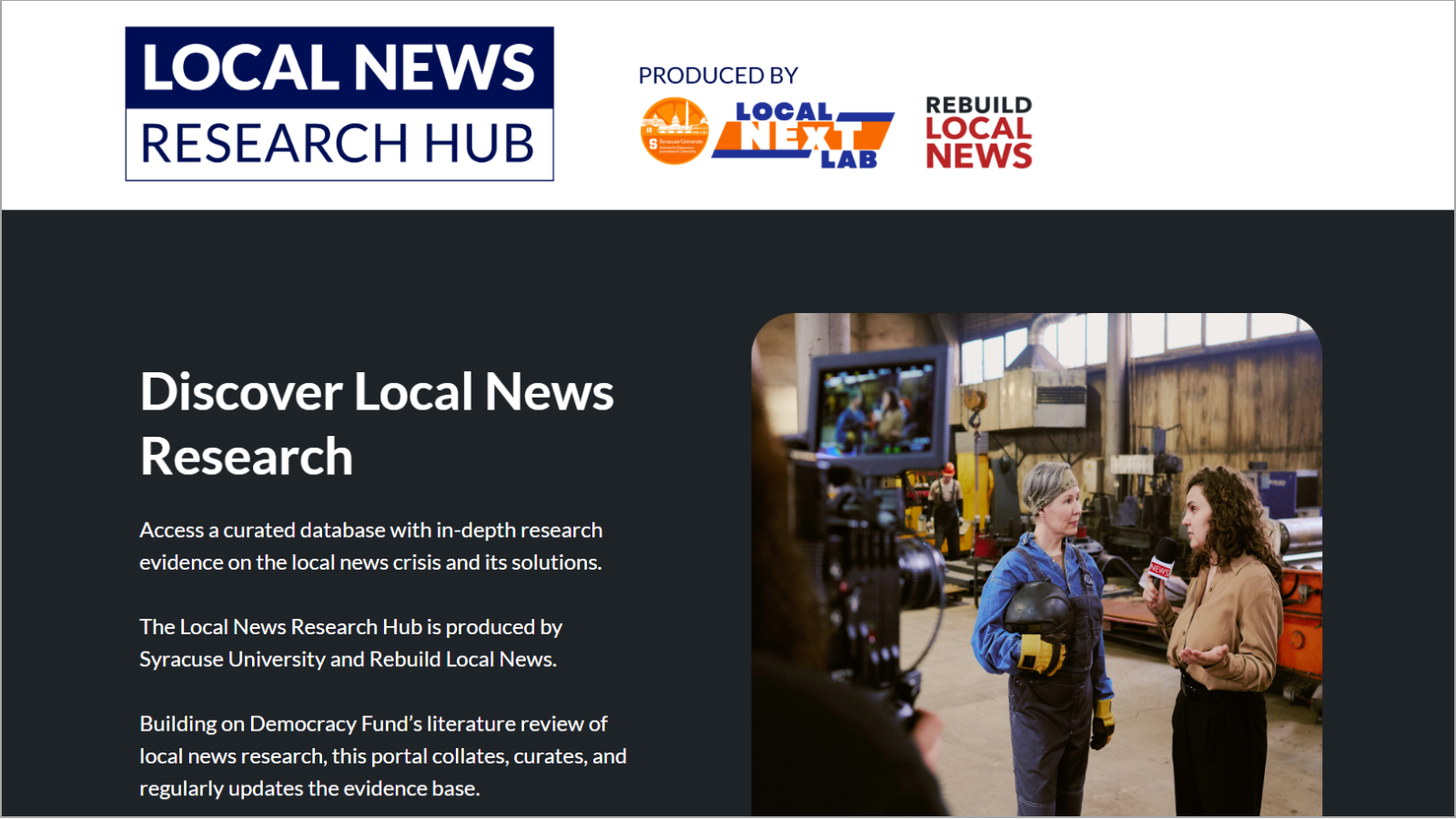
In partnership, the Local NExT Lab at Syracuse University’s Institute for Democracy, Journalism and Citizenship (IDJC) and Rebuild Local News have launched the Local News Research Hub, a centralized, curated database that brings together the growing body of research on the local news crisis and its solutions.
“Though the industry is facing many crises and issues, it’s an exciting time to study local news,” said Dr. Joshua Darr, IDJC senior researcher, Local NExT Lab director and associate professor in the S.I. Newhouse School of Public Communications. “There is so much good work being done across disciplines, we wanted to help ensure that the industry can benefit and use this research to make arguments to policymakers, funders and audiences about their civic and economic value.”
Since the beginning of the 21st century, the American local news ecosystem has been shrinking. Nearly 40 percent of all local U.S. newspapers have disappeared, leaving an estimated 50 million people with little or no access to reliable community information. The number of local journalists has fallen by more than 75 percent since 2002, according to the Local Journalist Index produced by Rebuild Local News and Muck Rack. At the same time, academic and practitioner research examining the drivers and implications of the local news crisis has expanded significantly.
The Local News Research Hub brings this work together in one interdisciplinary home, with 170 studies spanning academic articles, books, dissertations, working papers and research reports from fields such as communications, economics and political science. These studies examine core dimensions of the local news ecosystem, including business models, government accountability, economic impact, voter turnout and engagement, and other indicators of community health.
“To move the needle on policy, we need more than just anecdotes; we need data and evidence that demonstrates the specific needs and measurable impact of local reporting,” said Steven Waldman, president of Rebuild Local News. “The Local News Research Hub provides that essential evidence, showing policymakers exactly how a lack of local news leads to higher taxes, increased corruption, and lower civic engagement. By identifying these gaps, we can help craft targeted solutions that ensure every community has the information it needs to thrive.”
The Hub is designed to help local newsrooms, funders, policymakers and researchers quickly access relevant, emerging evidence, making this research easier to find and use. By bringing these studies together in one place, it enables users to understand local news landscapes, identify where news deserts are expanding, assess community‑level impacts, and guide more targeted investments and policy interventions.
Users can search the database, review key findings and summaries, and access peer‑reviewed articles, working papers, theses, dissertations, think‑tank reports and academic books or book chapters. The Hub builds on Democracy Fund’s foundational literature review of local news research, expanding and updating it to reflect the rapidly evolving landscape.
“We know a lot about why local news is declining and what’s at stake for communities,” said Dr. Johanna Dunaway, IDJC Research Director and professor of political science in the Maxwell School of Citizenship and Public Affairs. “This resource bridges the gap between that research and the people positioned to do something about it.”
“Strengthening local news reduces polarization and empowers communities,” said IDJC Kramer Director Margaret Talev, a professor of practice of magazine, news and digital journalism at the Newhouse School. “We are proud of Local NExT’s innovative work and our partnership with Rebuild Local News.”
To keep the Hub aligned with the rapidly expanding body of work on local news, users are encouraged to submit studies for review. These additions help ensure the database remains a living, comprehensive resource that can guide effective action across the field.
For more information, contact Dr. Darr at jpdarr@syr.edu or Matt Baker, research director at Rebuild Local News, at mattbaker@rebuildlocalnews.org.
Rebuild Local News is the leading nonpartisan, nonprofit coalition developing and advancing effective public policies designed to strengthen community news and information. Its 55 organizations represent over 3,000 newsrooms and 15,000 journalists working together to revive local news. For more information, visit https://www.rebuildlocalnews.org/.
The Local News Experimental Testing Lab (Local NExT Lab) develops and conducts testing to help newsrooms determine what attracts and informs their target audiences and to scale implementation of validated tactics. For more information, visit https://idjc.syracuse.edu/local-next-lab/.
The Institute for Democracy, Journalism and Citizenship (IDJC) engages in research, teaching and experiential learning, partnerships, and events to address challenges to democracy related to the information environment. The IDJC is a joint initiative of Syracuse University’s Newhouse and Maxwell Schools. For more information, visit https://idjc.syracuse.edu/.

Get the latest on local news legislation, industry developments, and more with our monthly newsletter.