




New Report Reveals Local News Shortage is Costing Communities $1.1 Billion a Year
Researchers link expanding news deserts to higher borrowing costs for local governments, based on analysis of bond‑market data
A shortage of local news costs Americans financially – roughly $1.1 billion per year in higher borrowing costs for local governments, according to a new report by Matthew Baker, research director of Rebuild Local News, and Dermot Murphy, a finance professor at the University of Illinois Chicago.
The analysis builds on a landmark 2020 municipal bond market study by Murphy and two co-authors, which found that when local news disappears in places already struggling with weak coverage, municipal borrowing costs rise. Without journalists monitoring local officials, the risk of wasteful spending and corruption increases. Lenders respond by charging higher interest rates, and those added costs ultimately fall to local residents through higher taxes or reduced services.
“Our original study illustrated that the loss of local news leads to a significant increase in borrowing costs for local governments, as lenders are nervous about lending to unmonitored governments,” said Murphy. “This follow-on report shows just how much the nation and each state pays in extra borrowing costs per year due to their news desert footprints. The costs are significant, and taxpayers ultimately foot the bill.”
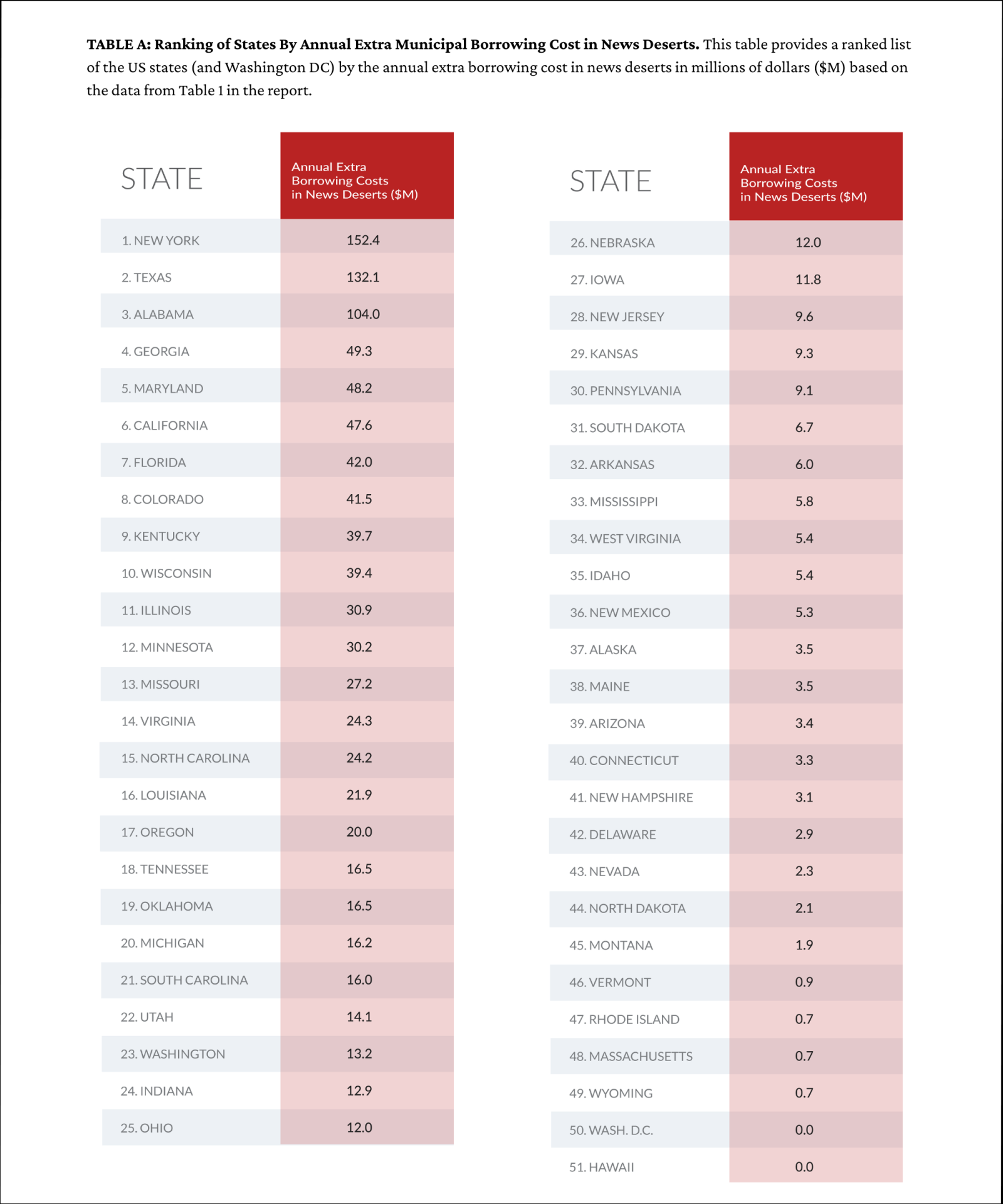
The new report quantifies those costs nationally and state by state. Baker and Murphy estimate that local governments in news deserts pay $1.1 billion per year in excess interest costs alone.
The burden varies widely across states, depending on the size of each state’s news desert footprint and how much it relies on the municipal bond market. States with the highest total annual costs include New York ($152 million), Texas, ($132 million), Alabama ($104 million), Georgia ($49 million), and Maryland ($48 million).
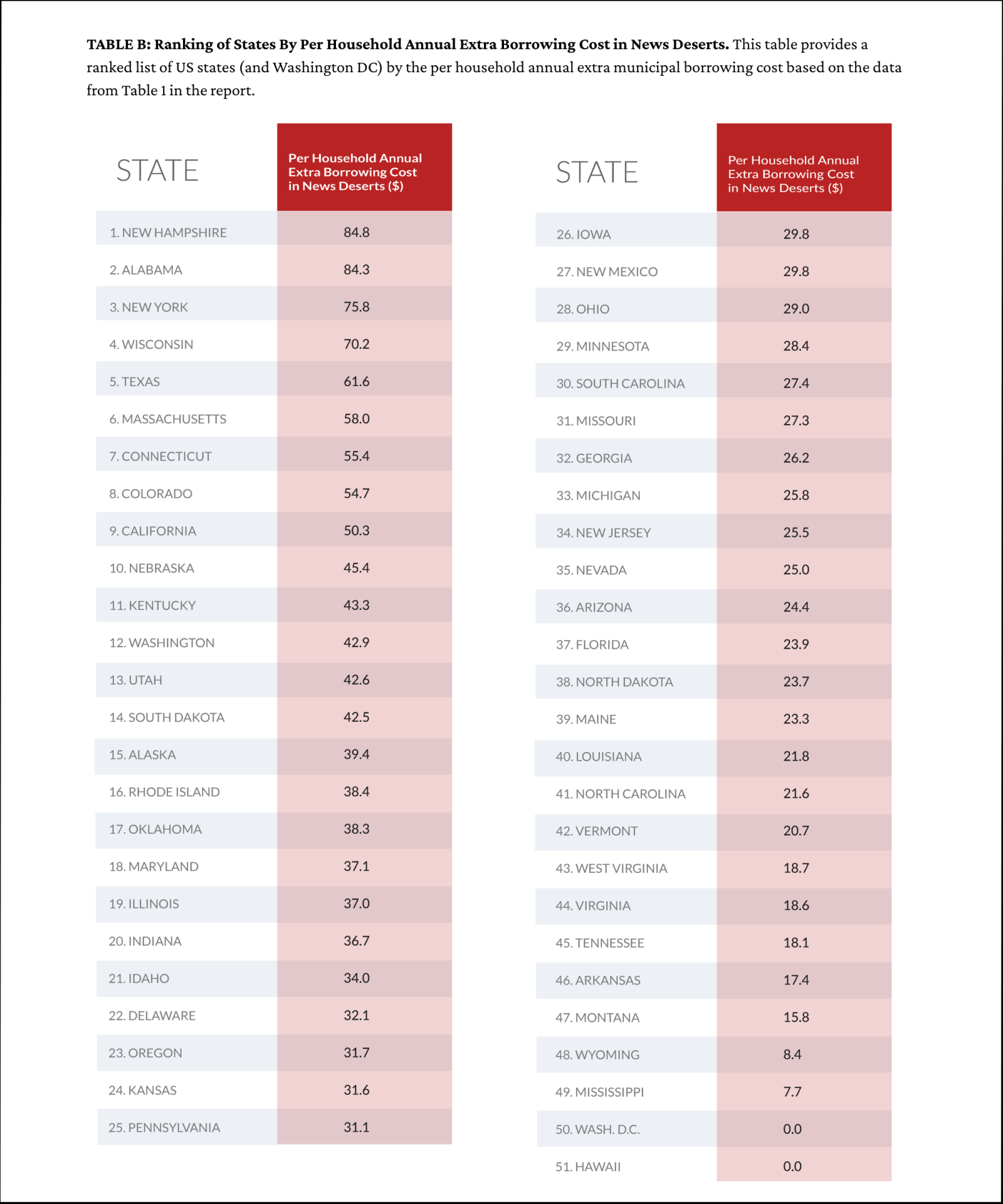
On a per-household basis, the states facing the largest annual costs are New Hampshire ($85 per year), Alabama ($84 per year), New York ($76 per year), Wisconsin ($70 per year), and Texas ($62 per year). The authors note that these costs function as an indirect tax on households stemming from a lack of local news coverage.
“The national price tag is striking, but the state‑by‑state numbers make the impact unmistakable. They show that news deserts aren’t just a civic concern; they carry real financial costs for communities across the country,” Baker said.
Borrowing costs are only one way that local news saves governments money. Governments routinely collect billions of dollars in fines from companies based on evidence surfaced by journalists. Additional research has shown that communities with more local reporting see stronger economic activity and therefore more tax revenue.
The findings of this report have clear policy implications. For example, subsidies that stabilize local watchdog reporting could produce measurable public benefits by reducing borrowing costs and recovering dollars otherwise lost to higher interest rates.
As a point of reference, legislation introduced in the U.S House of Representatives in 2021 (H.R. 3940) proposed newsroom subsidies to retain or hire local reporters. Its annual cost was $340 million, roughly one-third of what the country could save by eliminating news deserts and lower municipal borrowing costs. Such support would strengthen the fourth estate of democracy while also delivering a high return on investment by offsetting the fiscal costs documented in this report.
The evidence points to a simple conclusion: Stronger local news would reduce borrowing costs and deliver meaningful savings for communities nationwide.
“Government investment in reviving local news will pay for itself, and then some,” said Steven Waldman, president of Rebuild Local News.

Get the latest on local news legislation, industry developments, and more with our monthly newsletter.