




New Local Journalist Index Reveals 2026 Data on Local News Crisis
Rebuild Local News and Muck Rack report that 70% of counties are severely undercovered – employing below-average numbers of local journalist equivalents – and large number of counties have hardly any coverage of education and health
MIAMI and BROOKLYN — The 2026 Local Journalist Index, a landmark annual study by Muck Rack, the AI communications platform, and Rebuild Local News, the leading nonpartisan organization advancing public policies to strengthen community news, reveals that the shortage of local journalists persists and also finds a dramatic lack of education and health care coverage in most communities.
The study used Muck Rack’s expansive journalist database and a new analysis of 4.2 million articles published from January through March 2026:
Key Findings
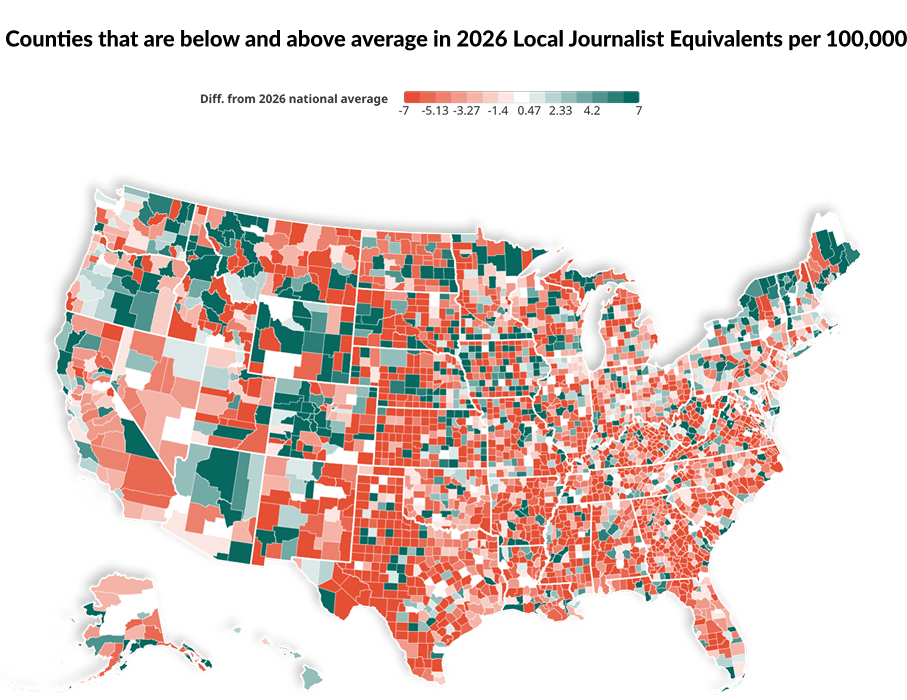
The reporter shortage persists unabated. The national average now stands at 7.8 Local Journalist Equivalents (LJEs) per 100,000 residents, an 81% decline from roughly 40 per 100,000 in 2002. Last year, we found 8.2 LJEs per 100,000 residents. Approximately 70% of U.S. counties, home to an estimated 209 million people, fall below even the already-anemic national average. Only 33 counties match the average number of journalists from 2002.
There is shockingly little education and health coverage. In the analysis of all American counties, they found no education articles mentioning a community by name in 77% of counties in the first quarter of 2026. Seventy-six percent produced no local health coverage. The same pattern holds for environment (77%) and transportation (82%).
When there are fewer journalists, the portion of coverage devoted to crime actually goes up. In counties with fewer than five LJEs per 100,000 residents, nearly one in five local articles about crime and justice, roughly 50% more than in counties with higher journalist density.
The financial cost is measurable. States with fewer local journalists face estimated municipal borrowing costs roughly 17% higher than average, part of what new research estimates as at least $1.1 billion in annual financial harm to communities nationwide.
Where journalism is stronger, civic participation is higher. Counties in the bottom fifth for journalist density score an average of 40 on the Civic Participation Index—a composite measure of voter turnout, volunteering, charitable giving and civic involvement—compared to 58 in the top fifth. In double-desert counties—places with both less than one Local Journalist Equivalent per 100,000 residents and, according to the landmark Local News Initiative at Northwestern University’s Medill School, zero local news outlets—the average falls to 23 out of 100.
Research suggests a link between local news and loneliness levels. A working paper by Danny Hayes and Anusha Trivedi, political scientists at George Washington University, has found that states with weaker local news environments have higher rates of loneliness, even after controlling for rurality. LJE data reinforces the findings: In every matched pair of states with comparable rural populations, the state with fewer journalists per resident also had a higher loneliness rate.
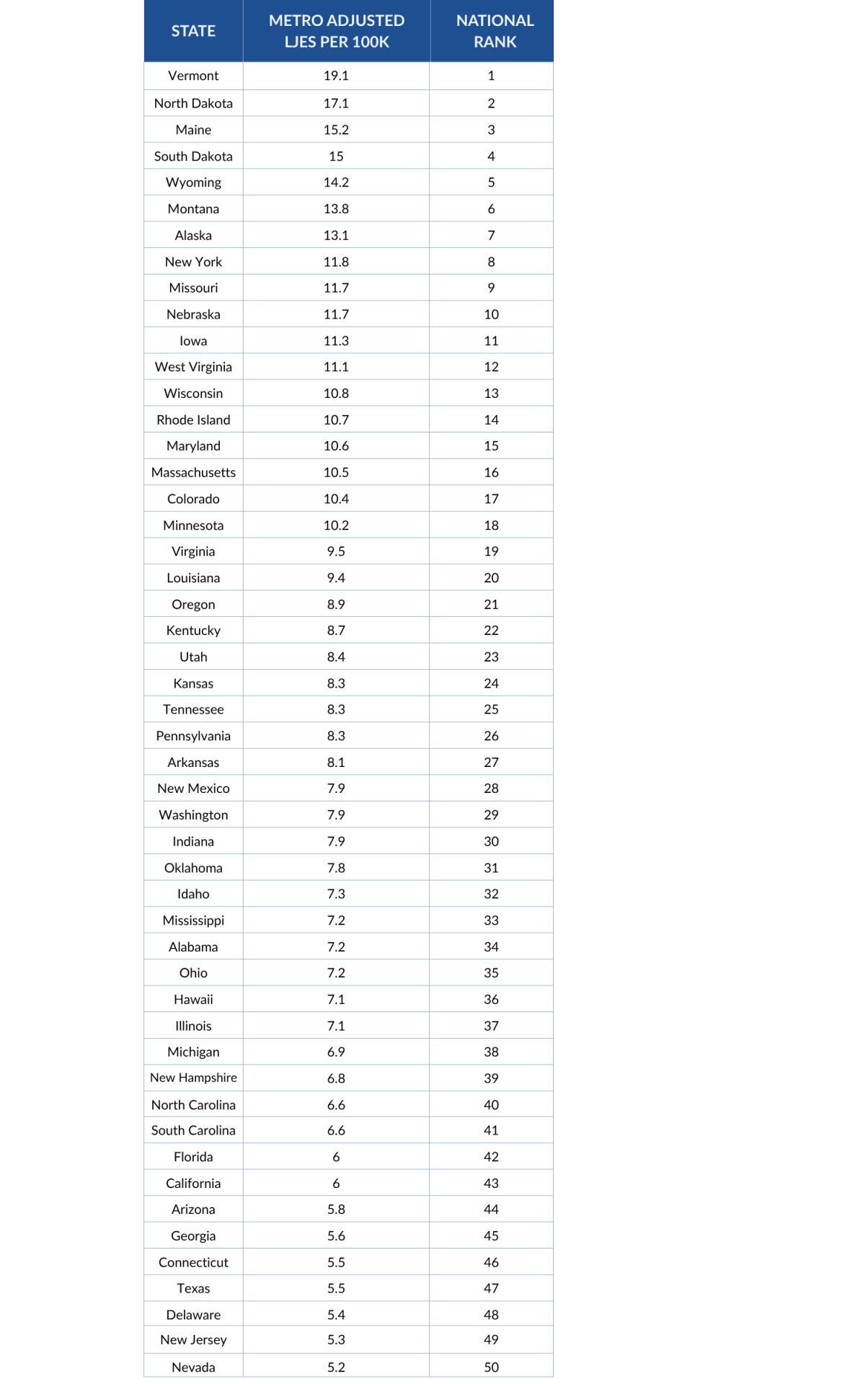
Some communities are models for what’s possible. Maryland ranks 16th nationally with 10.6 LJEs per 100,000, reflecting active investment in local journalism. The Baltimore Banner, launched in 2022, has grown to 100 journalists serving 82,000 paid subscribers, and its health coverage runs nearly five times the national average. And it’s a rare two-newspaper town, with the Baltimore Sun continuing to provide coverage. Vermont again leads the nation at 19.1 LJEs per 100,000, anchored by VTDigger, Seven Days and Vermont Public, alongside locally owned legacy papers and a growing digital sector.
The report includes:
- An interactive map showing the number of Local Journalists Equivalents per 100,000 residents for every county
- A ranking of reporting capacity by state
- Analysis of local news and loneliness levels
- Comparisons with the Civic Information Index
- Analysis of LJEs and municipal borrowing costs
As they did last year, Muck Rack and Rebuild Local News are making the full dataset available to researchers and others interested in diving deeper.
“This report is difficult to stomach,” said Steven Waldman, founder and president of Rebuild Local News. “The shortage of local reporters remains so severe that communities are being left in the dark as coverage of education, healthcare, and core civic issues thins out or disappears altogether.”
“We hope this data informs smarter investments in local journalism and drives urgent policy conversations,” said Gregory Galant, co-founder and CEO of Muck Rack. “Local journalists are the backbone of community trust and accountability. The stakes are too high to let this trend continue.”
The full 2026 Local Journalist Index, including comprehensive county- and state-level maps, rankings and data, is available at localjournalistindex.com.
About the Methodology
The 2026 Local Journalist Index is built on journalist-level data from Muck Rack’s media database, which monitors activity across digital, broadcast, print, podcast, newsletter and social media. Rebuild Local News and Muck Rack use this data to calculate Local Journalist Equivalents (LJEs), by looking at publishing frequency, outlet type, geographic focus and journalist verification, with adjustments for part-time contributors, opinion writers and multi-outlet journalists. The article analysis draws on 4.2 million articles published January through March 2026, filtered to 181,949 pieces with a confirmed local geographic signal. Topical classification used a combination of topic modeling and AI-assisted categorization against two frameworks: IPTC international topic codes and the FCC’s Critical Information Needs categories. Year-over-year comparisons should be interpreted with care; 2026 methodology refinements make this the new baseline for future editions of the index.
About Muck Rack
Muck Rack is the AI communications platform where trusted data, human expertise, and embedded intelligence come together to drive clarity, speed and impact. Thousands of companies turn to Muck Rack to make sense of the media conversation around them and understand how their brand shows up in the news and in AI-generated answers. Muck Rack combines global media monitoring, Generative Engine Optimization (GEO) insights, social listening, trusted media data, AI automation, and analyst advisory to help organizations manage reputation, act quickly, and prove their impact across the PR workflow. Thousands of journalists also use Muck Rack’s free tools to showcase their work and analyze the news. Learn more at muckrack.com.
About Rebuild Local News
Rebuild Local News is the leading nonpartisan, nonprofit coalition developing and advancing effective public policies designed to strengthen community news and information. Our broad-based organization brings together the largest alliance of local publishers, labor unions, civic organizations and newsrooms representing both rural and urban communities. Together, these 55 organizations represent over 3,000 newsrooms and 15,000 journalists working together to revive local news.
Contacts:
Ray Garcia
raygarcia@rebuildlocalnews.org
Linda Zebian
linda@muckrack.com

Get the latest on local news legislation, industry developments, and more with our monthly newsletter.